Is It Safe to Lift Your Dog by the Harness Handle?
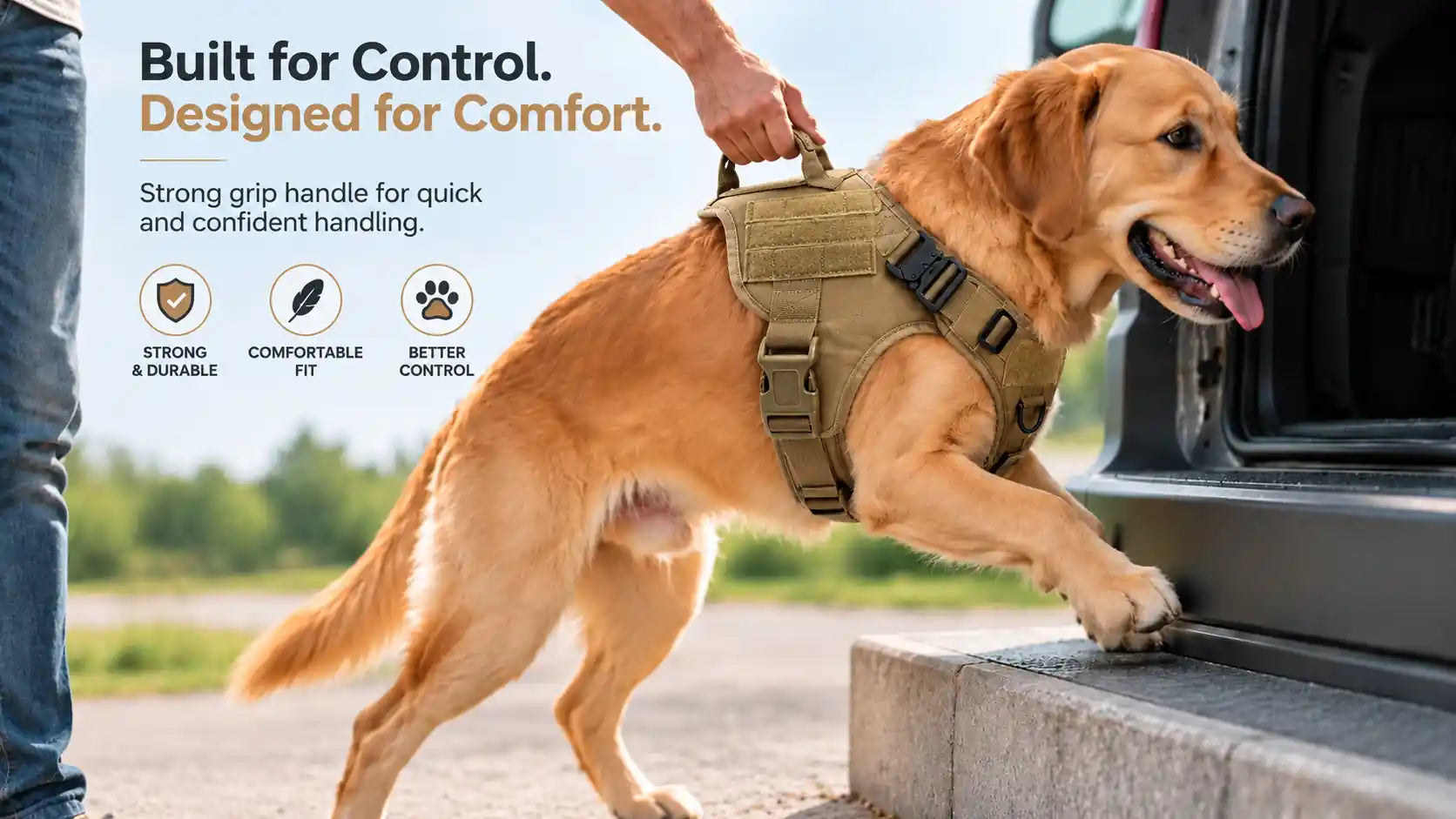
A dog harness grab handle is safe for brief steadying, like guiding your dog over a curb, into a car, or through a crowd. It is not designed for fully lifting or suspending your dog's whole body weight for an extended period. For a real lift, always support your dog's chest and hindquarters with your hands rather than relying on the handle alone.
Grab handles have become a standard feature on most tactical and no-pull harnesses, and for good reason. They give you fast, direct control in situations a leash alone can't handle. However, a lot of owners aren't sure exactly what the handle is meant for and what it isn't. This guide answers that clearly, using real safety guidance rather than guesswork.
What Is the Grab Handle on a Dog Harness For?

The grab handle sits on top of the harness, usually along the dog's shoulders, and gives you a quick, sturdy point to grab in a hurry. It's built for moments that need fast reaction, like stopping your dog from lunging at another dog, guiding it away from something dangerous, or helping it hop into the back of a car. Think of it as a backup steering point, not a substitute for the leash during normal walking.
Are Dog Harness Handles Safe?
Yes, when used the way they're intended. A well-made handle with reinforced stitching can safely take quick tugs and brief upward pressure, such as helping your dog up a step or out of water. The safety concern comes from using the handle to fully lift and carry a dog's entire body weight, especially for more than a few seconds. Doing this regularly can put uneven strain on the shoulders and spine, particularly in larger or older dogs. Brief, occasional use is safe. Sustained lifting is not what the handle is built for.
Can You Lift a Dog by the Harness Grab Handle?

You can lift a dog briefly by the handle, for example, to help it into a vehicle or up a curb, but this should be a quick assist rather than a full suspension. For anything longer, like carrying an injured dog any real distance, use both hands to support the chest and rear separately, the same way a vet or groomer would lift a dog. This spreads the weight evenly instead of concentrating it all on the shoulder area where the handle sits.
How Much Weight Can a Harness Handle Hold?
Reinforced handles with bar-tack stitching and metal hardware, like the one on the Fortress Edge tactical dog harness, are built to handle sudden tugs and brief lifts well beyond a dog's own body weight. However, weight capacity of the stitching is not the same question as whether sustained lifting is safe for your dog's joints. A handle might hold the weight just fine while still being the wrong way to carry a dog for an extended period. Always separate "can the handle physically hold this" from "is this safe for my dog's body."
When Should You Use the Handle?
Use the handle for quick, short moments: guiding your dog past a distraction, helping it into a car or up a step, or steadying it during a vet visit. Avoid using it to carry your dog any real distance, to suspend it fully off the ground for more than a couple of seconds, or as a way to pick up a dog that's resisting or in pain. If your dog needs regular lifting help due to age, injury, or mobility issues, a dedicated lifting harness with a sling design is a safer, more comfortable choice than a standard grab handle.
Grab Handle Designs Compared
Not all grab handles are built the same. Here's how a few well-known tactical harness brands compare on handle design.
|
Brand |
Handle Design |
Best Use |
Approx. Price |
|
Fortress Edge |
Reinforced, padded top handle with metal quick-release buckle |
Brief control, guiding into a car, steadying on stairs |
$75-$90 for the full 5-piece set |
|
OneTigris |
Padded handle, sometimes two handles on larger models |
Brief control, quick grabs in crowded areas |
$25-$45 for the harness alone |
|
rabbitgoo |
Single top handle on most tactical models |
Brief control during walks and training |
$25-$45 for the harness alone |
All three brands use the handle for the same basic purpose: quick, brief control rather than full lifting. OneTigris and rabbitgoo both offer solid padded handles on their tactical models, sold as the harness alone. The Fortress Edge tactical dog harness pairs its reinforced handle with a metal quick-release buckle and includes the leash, pouch, waist bag, and water holder in the same box, so you're not left buying accessories separately after the fact.
What Do Vets and Trainers Say About Harness Handles?
General guidance from trainers and rehabilitation professionals lines up on this point: use the handle for control, not for carrying. Dogs recovering from injury or surgery, or those with back and joint conditions, should never be lifted by a harness handle at all without direct veterinary guidance, since uneven lifting can worsen certain conditions. For healthy dogs, the occasional quick assist is considered safe, but it should never replace properly supporting the dog's body during any longer lift, such as getting an injured dog into a car.
Does Dog Size Change the Answer?
Yes. A small dog under 15 pounds puts far less strain on a handle and on its own body during a brief lift than a large breed weighing 60 pounds or more. For small dogs, a quick lift by the handle alone is generally low-risk. For large or giant breeds, even a brief lift by the handle should be paired with a second hand supporting the body, since the shoulder area alone isn't built to bear that much weight safely, even for a few seconds.
Signs Your Dog's Harness Handle Needs Replacing
Check the stitching around the handle every few months, especially if you use it often. Frayed threads, a handle that feels loose from the vest, or visible cracking in the padding are all signs it's time to replace the harness rather than risk it failing during a moment you actually need it. A handle that fails during a quick grab, like pulling your dog back from traffic, defeats the entire purpose of having one.
Alternatives if Your Dog Needs Regular Lifting Help
If your dog needs frequent help getting up stairs, into a car, or standing due to age or injury, a standard grab handle isn't the right tool for that job. Dedicated lifting harnesses, sometimes with slings under the belly or hips, are designed specifically to distribute weight safely across multiple points during regular assisted movement. These are a better fit for senior dogs, dogs recovering from surgery, or breeds prone to joint issues, while a tactical harness handle remains best suited to quick, occasional control during everyday walks.
Frequently Asked Questions
What is the grab handle on a dog harness for?
It gives you a quick, sturdy grip for brief control, like guiding your dog away from danger or helping it into a car.
Are dog harness handles safe?
Yes, for brief tugs and short lifts. They are not meant for fully carrying a dog's body weight for an extended time.
How much weight can a harness handle hold?
A reinforced handle can physically hold significant weight, but that's different from whether sustained lifting is safe for your dog's joints and spine.
When should you use the handle?
Use it for short, quick moments of control. For longer lifts, support your dog's chest and rear with both hands instead.
Final Thoughts on Using the Harness Handle Safely
A tactical harness handle is one of the most useful safety features on a modern harness, as long as you use it the way it's meant to be used. Quick control, yes. Full-time lifting, no. Keeping that distinction in mind protects your dog's comfort and keeps the handle doing its job for years.
If you're looking for a harness with a reliable, reinforced grab handle built in, check out the tactical dog harness from Fortress Edge, complete with metal buckles and sizes from S to XL.